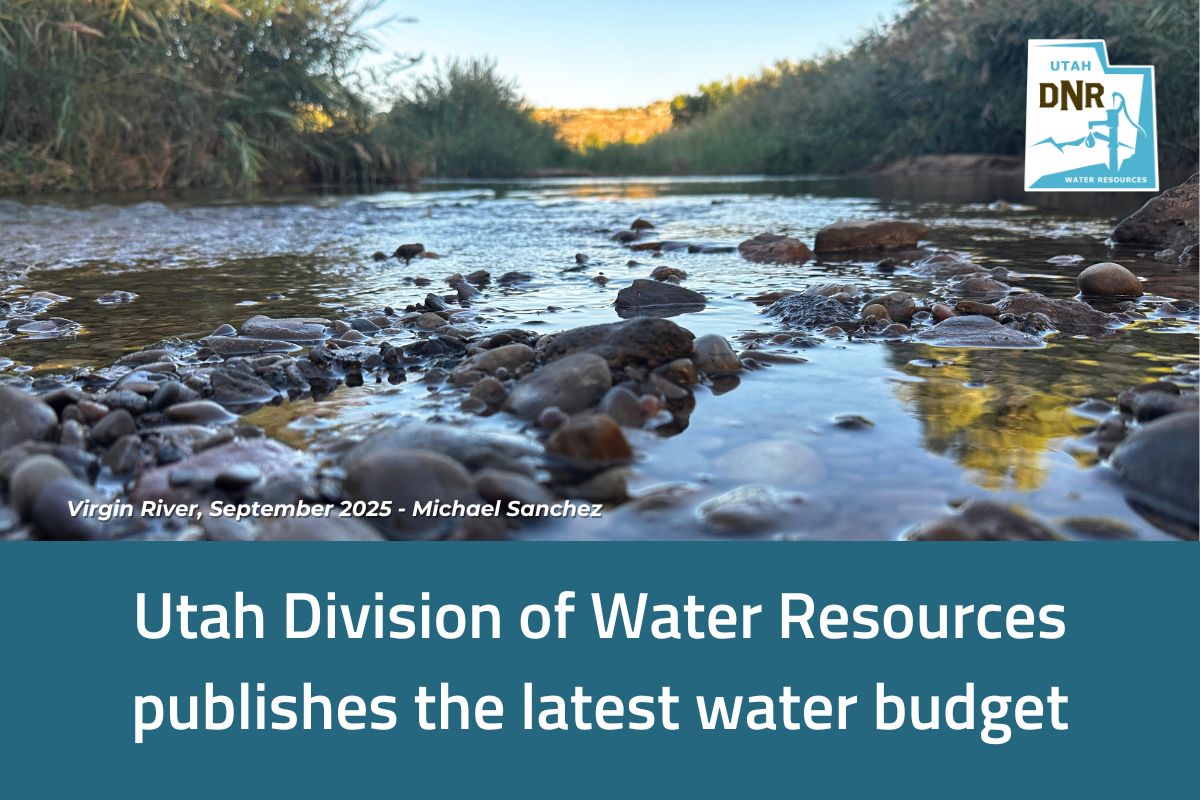
SALT LAKE CITY (Dec. 22, 2025) – The annual run of the Utah Water Budget model has been completed for 1989-2024 water years. Improvements to methods have resulted in more accurate accounting of water use across the state. The Water Budget is a model that helps decision-makers understand and predict the state’s water supply (surface water inflow, precipitation and storage), water use per sector (diversions and depletions through agriculture, municipal and industrial “M&I” use) and how much water leaves the state (surface water outflow).
Understanding water diversions (total water diverted for water users) and depletions (water removed from the system through consumption, evaporation or evapotranspiration) is fundamental to water planning. In addition to the new data published on the division’s website, a summary of the updates has been provided. More detailed documentation will also be available in early 2026.
“The division is constantly looking for new research and data to improve the model results. The latest model improvements give us a more precise and realistic picture of where our water is being consumed, which is essential for making informed decisions on conservation and future water management across all sectors of the state,” said Leila Ahmadi, Hydrology and Modeling section manager for the Utah Division of Water Resources.
Some of the key improvements this year include:
- Updated proportion of water for residential indoor and outdoor use: Utilization of winter (indoor) versus summer (indoor and outdoor) source data provides a more accurate estimate of what portion of residential deliveries goes to outdoor irrigation.
- Amended amounts of municipal outdoor depletion: Research shows a much higher percentage of outdoor M&I water is depleted than previously assumed, leading to a substantial correction in total M&I depletions.
The improved water budget model highlights several key findings:
- Higher outdoor depletions from the residential sector are estimated.
- Overall, municipal and industrial water depletion shows an increasing trend across the state.
- The specific trends in agricultural and M&I water depletions differ across river basins.
You can explore more information regarding the Utah Water Budget online and may contact Michael Sanchez, public information officer, at 385-226-8967 or email msanchez@utah.gov for any additional information.
###
The Utah Division of Water Resources is one of nine divisions and three offices housed within the Department of Natural Resources. Tasked with planning, conserving, developing and protecting Utah’s water resources, the division serves as Utah’s water steward.
For more information, contact Michael Sanchez, public information officer, at 385-226-8967 or email msanchez@utah.gov.