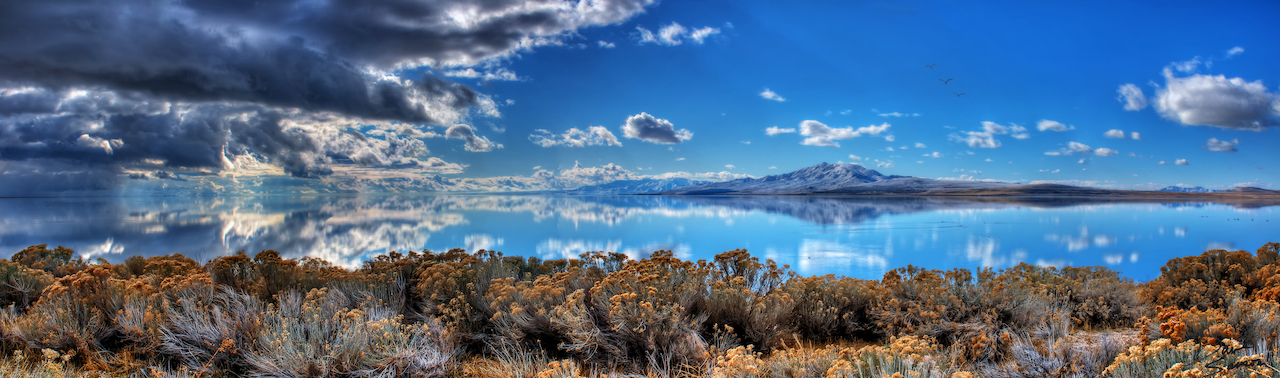
Image shows Echo Reservoir Boat ramp with mountains in the background

Drought Update 04/23/26

Published 04-23-26

SALT LAKE CITY (April 23, 2026) – In a typical year, Utah’s runoff – which refills our reservoirs – would just be getting underway. However, due to record-low snowpack and record-high temperatures, peak runoff has already come and gone. While larger reservoirs with multiple years of storage are doing well, smaller reservoirs with one or two years of storage capacity are struggling.  

On Tuesday, the Utah Department of Natural Resources met with county leaders and water providers to share critical data to support proactive resource management. Officials presented a bleak outlook for streamflow and runoff to help local leaders prepare for the coming months. 

“To address extreme drought, we are asking county leaders to coordinate with water providers and review drought contingency plans and consider if a county-specific drought declaration is warranted,” Joel Ferry, executive director of the Utah Department of Natural Resources, said. “While the state remains a resource for data and guidance, water planning – including any potential restrictions – takes place on a local level to reflect conditions in the area.”

The state’s Drought Response Committee, which consists of representatives from a variety of state agencies, is closely monitoring conditions and will make a recommendation to Gov. Spencer Cox if conditions warrant a statewide drought declaration, which is in effect for 30 days unless extended by the Legislature. Currently, 100% of the state is in some form of drought, and 59% is in extreme drought. 

Reservoir storage averages 72% full, which is slightly higher than normal for this time of year but down from 82% recorded last year. Statewide stream flow runoff is anticipated to be around 50% of normal. Natural inflows from the Colorado River into Lake Powell are expected to be 40% of normal this year. On March 21, Utah, Wyoming, Colorado and New Mexico approved a plan for the release of between 660,000 and 1 million acre-feet from Flaming Gorge Reservoir beginning as early as this week and extending through April 2027 in order to protect critical elevations at Lake Powell.

As noted in the Natural Resources Conservation Service’s April 1st Water Supply Outlook Report, every major basin in Utah had record-low snowpack as of April 1, and some were almost completely melted out. 

On April 28 at 8:30 a.m., DNR, Water Rights and Water Resources are holding a virtual media update/Q&A to highlight conditions. 

The Department of Natural Resources continues to promote initiatives such as the Agricultural Water Optimization Program for farmers and SlowtheFlow.org for residents. These programs aim to educate and incentivize water-saving practices, helping Utahns become more drought-resilient and better prepared for future conditions. Many indoor water-saving tips are available on the Slow the Flow website.  

# # #

For more information, contact Michael Sanchez, public information officer, at 385-226-8967 or email msanchez@utah.gov.

Image shows Great Salt Lake from Antelope Island

Gov. Cox Issues Drought Executive Order

Published 04-24-25

Water conservation critical as Utah’s water supply faces a drier year

Salt Lake City (April 24, 2025) – With low streamflow forecasts, increased water demand as temperatures rise and southern Utah experiencing extreme drought, Gov. Spencer J. Cox issued an Executive Order today declaring a state of emergency in 17 counties due to drought conditions. The counties include: Washington, Iron, San Juan, Kane, Juab, Emery, Grand, Beaver, Garfield, Piute, Millard, Tooele, Uintah, Carbon, Sevier, Sanpete and Wayne. This declaration reflects USDA’s disaster classifications that are informed by the U.S. Drought Monitor and NRCS’s water supply report.

(more…)

Utah Water Conditions Update January 2025

Published 01-16-25

SALT LAKE CITY (Jan. 16, 2025) – Northern Utah has experienced near-normal precipitation, although much of it has been in the form of rain rather than snow, which could affect water storage for the spring melt. In southern Utah, however, snowpack remains 27-64% of normal for this time of year, continuing dry conditions in that region. 

(more…)

Gov. Cox appoints and Senate confirms Joel Ferry as new water agent

Published 09-19-24

SB 211 looks to enhance state’s water management

SALT LAKE CITY (Sept. 18, 2024) – Gov. Spencer Cox has appointed, and the Senate has confirmed, Joel Ferry as the state’s water agent as outlined in SB 211. Ferry currently serves as executive director of the Department of Natural Resources and will continue in this role while assuming water agent duties. 

(more…)

Utah Water Conditions Update

Published 08-14-23

SALT LAKE CITY (Aug. 14, 2023) – As scorching heat returns to Utah, the state’s reservoirs have become crucial sources, fulfilling the needs of residents, agriculture and municipalities. In these times of reliance on water reserves, fostering a waterwise mindset is imperative to ensure sustainability during the inevitable dry years ahead. 

(more…)
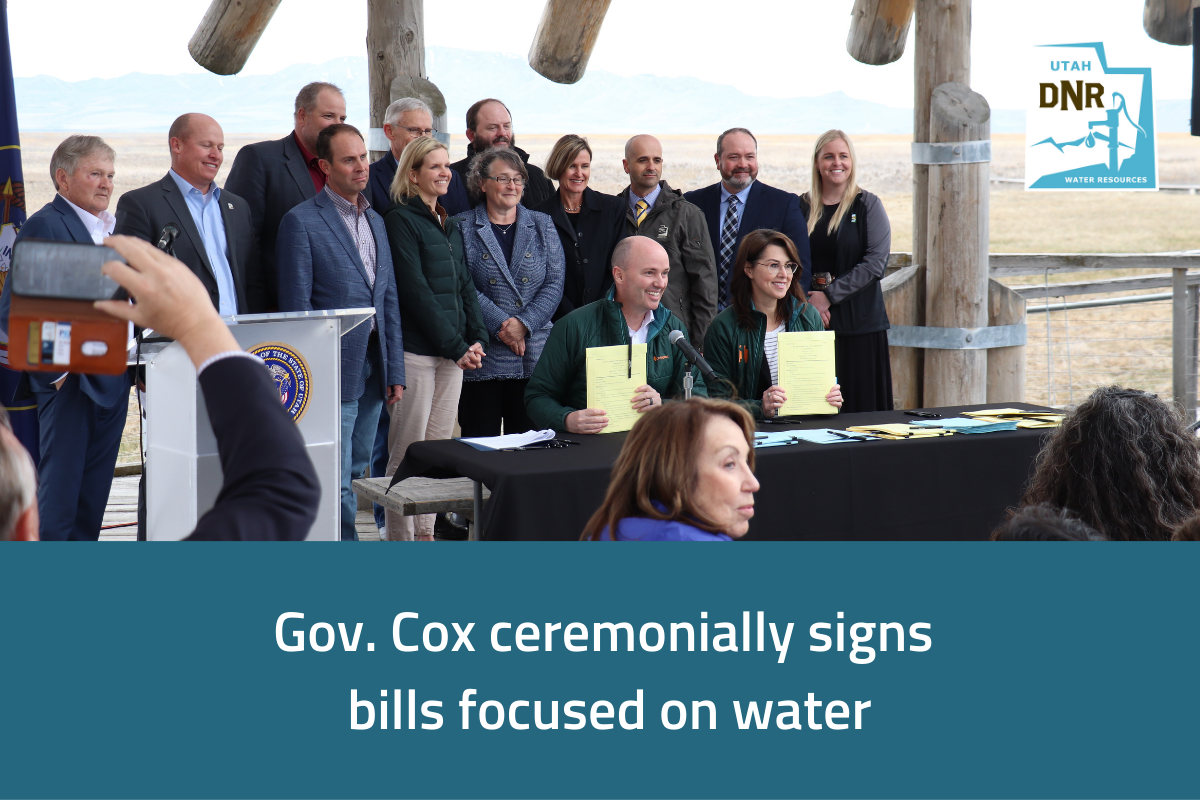
Picture show Governor Cox with the Lt. Governor signing bills with state agency professionals in the background.

Gov. Cox ceremonially signs bills focused on water

Published 04-26-23

SALT LAKE CITY (April 25, 2023) — For the second year in a row, the legislative session concluded with significant investments targeting water conservation, efficiency and infrastructure. Our record-breaking winter that delivered the deepest snowpack in state history has certainly helped with our drought conditions, but there’s still a ways to go. These bills will help Utah become more waterwise and drought resilient. Here are some highlights: 

(more…)

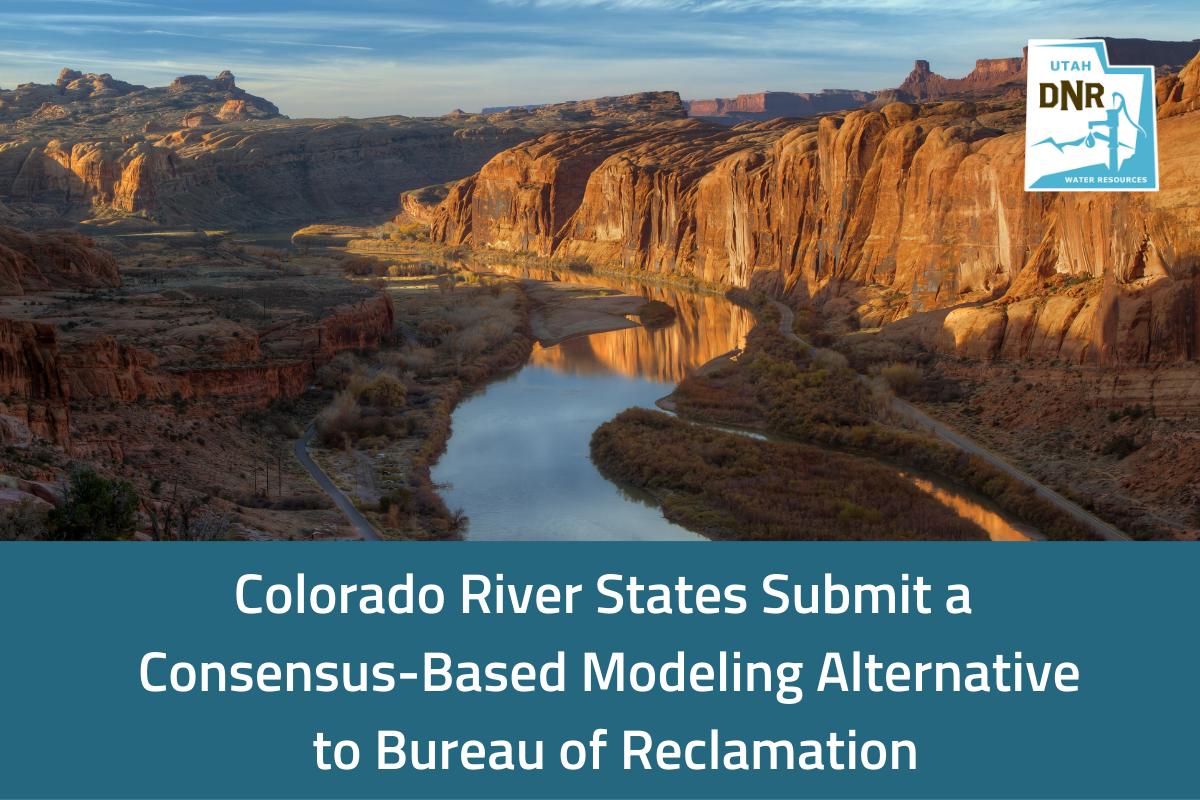
 Colorado River States Submit a Consensus-Based Modeling Alternative to Bureau of Reclamation 

Published 01-31-23

Six states reach consensus on criteria for environmental review to help protect lakes Powell and Mead 

January 30, 2023 – Today, states sharing the Colorado River submitted a letter to the Bureau of Reclamation (Reclamation) that outlines a Consensus-Based Modeling Alternative for Reclamation to evaluate and incorporate into its development of a Supplemental Environmental Impact Statement (SEIS) to revise current Operating Guidelines (’07 Guidelines) for Glen Canyon Dam at Lake Powell and Hoover Dam at Lake Mead. 

(more…)

Extension requested on Lake Powell Pipeline timeline

Published 09-24-20

The Utah Division of Water Resources and Washington County Water Conservancy District have requested an extended timeline from the Bureau of Reclamation (Reclamation) to consider comments received on the Lake Powell Pipeline’s draft Environmental Impact Statement (EIS) from the public, tribes, non-government organizations and fellow Colorado River Basin states.

“The Lake Powell Pipeline is a critical water infrastructure project for Utah,” said Todd Adams, director, Utah Division of Water Resources. “The extension will allow more time to consider the comments and complete further analysis, which will contribute to a more comprehensive draft and final EIS.”

(more…)
La Sal Mountain Loop on the Colorado River

Utah teams up with federal, state and water agencies to assess the state of the Colorado River

Published 04-09-20

As one of the seven states that make up the Colorado River Basin, Utah takes an active interest in this critically important river that provides water to 40 million people and 5 million acres of farmland. For the past three years, the Utah Division of Water Resources has partnered with the other basin states to form a workgroup to support climate and hydrology studies and centralize them to help guide management and planning efforts for the Colorado River. (more…)