At a press conference July 29, Gov. Spencer Cox was joined by water districts and St. George Mayor Michele Randall to highlight water-saving efforts underway around the state and announce conservation program expansions. Although drought conditions are discouraging, many Utahns are taking water-saving actions at their homes, businesses, communities, and industries.
Jordan Valley Water Conservancy District was the first in the state to offer rebates for turf park strip conversions with the popular “Flip Your Strip” program. Today, Central Utah Water Conservancy District and Weber Basin Water Conservancy District also launched turf removal programs designed to incentivize homeowners to remove grass that doesn’t serve an active purpose. (Visit UtahWaterSavers.com to find out about programs and rebates in your area.)
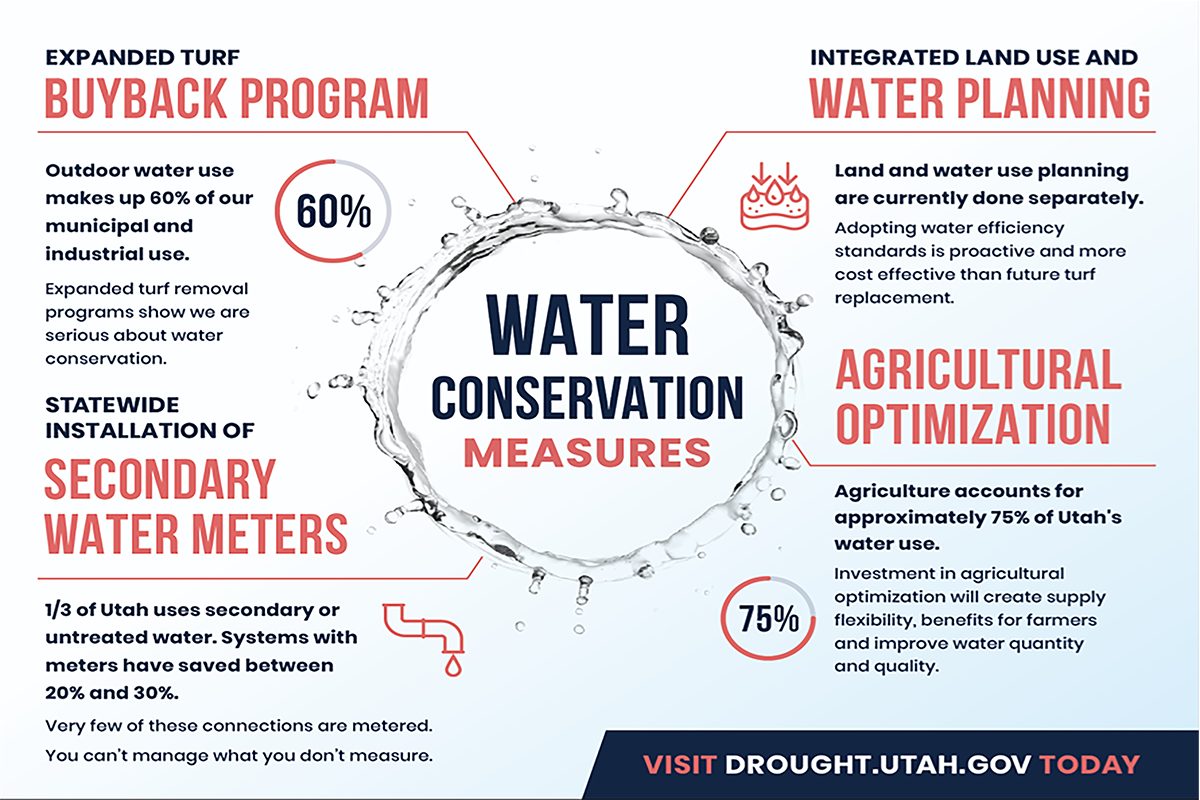
The governor announced four areas of focus he’s looking to fast-track to further advance water conservation and water planning:
- Statewide installation of secondary water meters
- About one-third of residential connections use secondary or untreated water. The majority of these connections are unmetered. And you can’t manage what you don’t measure.
- Areas that have installed secondary meters have seen a reduction in water use by about 20-30%. Installing secondary meters yields the biggest bang for the buck when you look at the amount of water saved compared to the cost of the meters. A number of cities in Utah County are fully metered (Spanish Fork, Saratoga Springs, Mapleton and Santaquin), and Weber Basin Water Conservancy District has installed over 11,000 connections.
- Over the last few years, legislation has been passed to require meters on new secondary connections, and $2 million has been appropriated in matching grant funds to offset the cost of the installation (in first and second class counties).
- This effort must be accelerated statewide.
- Integrated land use and water planning
- As the fastest growing state in the nation, how we grow and develop today will set our water use for decades to come.
- Land use planning is often undertaken independently of water planning efforts, even though the two can and should inform one another.
- Integrating these two processes and requiring water-efficient landscape ordinances from the beginning of any development proposal is cost-effective, compared to the expense of retrofitting existing development.
- We are enlisting the help of local officials in adopting water efficiency standards for new development.
- Agricultural optimization
- The State is facing critical long-term reliable water supply issues. The agricultural sector accounts for about 75% of the state’s total water use. So agriculture and agricultural water use need to be part of any water planning discussion.
- Over the last few years approximately $7.3 million has been invested in agricultural optimization for research and projects.
- A continued investment in agricultural optimization will help the State evaluate ways to improve agricultural water use practices, create benefits for farmers, optimize water use, and protect water quantity and quality for all uses in the system.
- Statewide turf buyback program
- Outdoor water use makes up about 60% of our municipal and industrial water use.
- Turf buyback programs like “Flip Your Strip” program help incentivize people to replace thirsty grass with waterwise options.
- These types of programs are typically offered at the local level – we’re not aware of any state that offers such a program. We want to be the first, and we are working to expand this program statewide.
- We need to plant grass in areas where it’s actively used rather than using grass as the default groundcover that’s only walked on when it’s mowed.
- Implementing a statewide rebate program will show Utah is serious about conservation and leading the way. These types of programs are also being expanded on a local level.
As evidenced by the Conservation Garden Park, waterwise landscaping can be beautiful and help stretch the water supply. It will take all of us – individuals, institutions, industries, communities, cities, businesses – working together to fight this drought and ensure drought resiliency into the future.
For more information, contact Kim Wells | 801-803-0336