2026 updates
Utah’s ground-based cloud seeding program is now fully remote, allowing for streamlined operations, improved safety and real-time reporting. This modernized, remotely operated generator network is the largest of its kind in the United States, covering mountain ranges across the entire state.
In addition, Utah is exploring the use of drone-based cloud seeding technology, replacing the airplanes tested between 2022-2025. Drones offer the potential for more precise targeting by flying directly into clouds and releasing seeding material at the optimal temperatures for ice nucleation helping enhance snowfall in key watersheds.
Evaluating cloud seeding effectiveness remains one of the most significant challenges in the field. The SNOWSCAPE 2026 research program will provide a major scientific advancement by collecting high-resolution data on atmospheric conditions, snowpack energy balance and other key variables. These measurements will calibrate two cutting-edge models that will simulate the effects of cloud seeding on natural precipitation.
Utah is also launching a comprehensive trace-chemistry study this year. This effort will analyze snowmelt, stream water, lake water, lakebed sediments and soils to measure extremely small concentrations of silver, down to parts per trillion. Previous studies have found little to no environmental impact from cloud seeding, but most of that work occurred more than a decade ago and outside Utah. To ensure cloud seeding continues to be safe and environmentally responsible, Utah is conducting a thorough, locally focused assessment.
Enhancing our water supply
Utah has been cloud seeding since the early 1950s to help augment the state’s water supply. The Cloud Seeding Act of 1973 gave authority to the Utah Division of Water Resources to oversee state cloud seeding projects. The Utah Legislature continues to support operational cloud seeding activities and pushes for innovation in the field.
Cloud seeding takes place in Utah from the months of November and into April. It only occurs during snowfall events where atmospheric conditions (such as temperature and moisture) favor the enhancement of snow – never under clear conditions.
How cloud seeding works
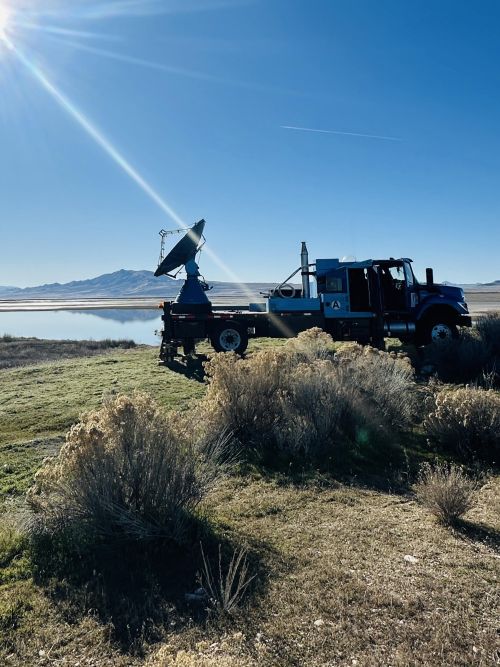
Utah uses both ground-based seeders and drones. In both seeding methods, silver iodide is dispensed into winter clouds to help form ice crystals. Ground-based seeders are placed along foothills and higher elevations, and the release of the silver iodide is timed so that air currents carry them high into the cloud. Drones operate inside the cloud for more precise targeting.
This process is effective because clouds are formed by water vapor and airborne particles (cloud condensation nuclei). Under certain natural conditions, water droplets will freeze together around the particles and, when heavy enough, fall from the sky as snow. Often, the amount of water that can fall as snow is limited by the number of particles around which ice crystals can form. That is why adding particles, or seeds, facilitates and accelerates the process. This may lead to more snow falling than would have under natural conditions.
White lines in the sky? Not cloud seeding
Occasionally, we’re asked if the white lines people see in the blue sky are related to our operations. Cloud seeding happens within or above clouds that are already producing some amount of snowfall. Because silver iodide is released inside winter storm clouds, cloud seeding does not produce visible white lines in the sky. You can learn about contrails – or condensation trails – in this NASA publication and this Environmental Protection Agency fact sheet.
Why Utah cloud seeds
Since snowpack is Utah’s largest reservoir, increasing the amount of snow that falls is a win for the water supply. It doesn’t work just anywhere. The conditions have to be right. Fortunately, Utah’s topography, climate and reservoirs make winter snowpack enhancement cost-effective. Statistical analysis shows an average increase in precipitation of 5-15% in seeded areas. The field program is funded jointly by the state and local water interests.
Cloud seeding can only occur when there is sufficient water in the atmosphere along with other meteorological parameters (i.e. during precipitation). It is a long-term water management strategy that enhances snowfall. See our FAQ sheet to learn more.
Environmental considerations
Cloud seeding is a scientifically validated method for enhancing snowpack, has been thoroughly researched and is conducted with transparency and strict adherence to environmental regulations.
Cloud seeding uses small amounts of silver iodide – a compound that exists naturally in the environment at low concentrations and is not known to be harmful to the environment, humans or wildlife – to aid in the formation of ice crystals. Silver and iodide have a strong covalent bond that keeps them insoluble in water and in a solid form. This keeps silver iodide safe, with only a maximum concentration of silver in water of 0.984 micrograms per liter – far below the natural background levels of silver in Utah and neighboring states and below the limits to impact aquatic life, drinking water and terrestrial plants.
Questions?
Contact: CloudSeeding@utah.gov
Additional Resources
- Cloud seeding blog series 1 | 2 | 3 | 4
- Cloud Seeding FAQ (May 2024 – update coming soon)
- 2023 Cloud Seeding Symposium Report (September 2023)
- Update on a Long-term Winter Operational Cloud Seeding Program in Central/Southern Utah (April 2022)
- Towards the Improvement of Winter Orographic Cloud (December 2019)
- Utah’s Cloud Seeding Suspension Criteria (May 2019)
- Geochemistry and Impacts of Silver Iodide Use in Cloud Seeding (May 2011)
- Weather Modification Association Environmental Impact Position Statement (July 2009)
Cloud Seeding Reports
2024-2025
- Book Cliffs 2024-2025
- Cache Valley UAV 2024-2025
- East Shore 2024-2025
- High Uintas 2024-2025
- Northern Utah 2024-2025
- Six Creeks 2024-2025
- Southern and Central Utah 2024-2025
- Western Uintas 2024-2025
Previous years available upon request from the division.