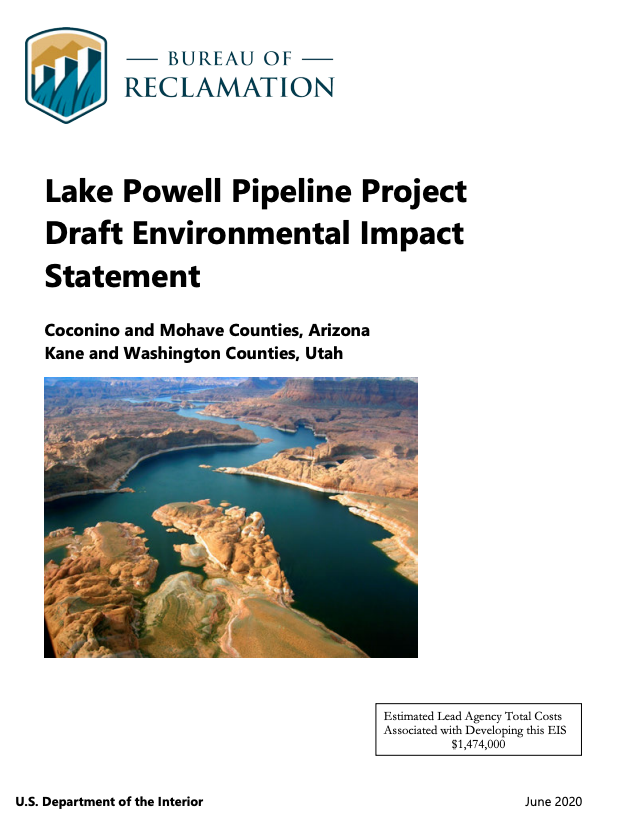
St. George, UT – After decades of study, the Lake Powell Pipeline has reached a critical milestone – the Bureau of Reclamation has issued the draft Environmental Impact Statement (EIS) and opened a public comment period. The Southern Alternative has been named the “preferred alternative.”
LPP will deliver up to 86,249 acre feet of water through a 140-mile underground pipeline to Washington County. The draft EIS studied the need, purpose and socioeconomic impacts and other important considerations for the project. It also outlined how the project can be built in a manner that protects the environment.
Some of the key findings are:
• Washington County needs more water.
• Washington County needs a second source of water.
• The project is the only alternative that meets Washington County’s water need.
• Conservation alone will not meet Washington County’s future water demand.
• The project is affordable and Washington County has the ability to repay the state of Utah to build the project.
• The project uses only a portion of Utah’s existing Colorado River water right.
• Short-term construction-related expenditures will produce more than $1.7 billion in total economic output and create more than 11,000 jobs for Utahns.
• The long-term benefit of a reliable water supply is worth over $2 billion.
• The project will benefit endangered fish and birds because it allows water to flow from the Green River to Lake Powell, benefiting Colorado River fish and designated critical habitat.
• The project will have minimal impacts to the landscape. Land disturbances will be short term and effects will be controlled through environmental protection measures that will avoid or minimize impacts.
• The project’s proposed environmental protection measures would be highly effective in minimizing temporary effects to plants and animals during construction.
Public comment is being accepted now through Sept. 8. Comments must be provided to Reclamation in writing via email, fax or regular mail. A link for directions on how to submit comments is found at LPPUtah.org.
“We appreciate the amount of work that has gone into this exhaustive review of the Lake Powell Pipeline,” said Todd Adams, director of the Utah Division of Water Resources. “This is a major step forward for this project that’s so important to our state. We encourage the public to review the studies and learn more.”
“Nothing is more important than ensuring our communities have a reliable water supply today and in the future,” said Zach Renstrom, general manager of the Washington County Water Conservancy District. “It’s important to make your voice heard on this critical project.”
Visit LPPUtah.org to learn more.
For more information, contact:
Kim Wells, Division of Water Resources PIO
801.803.0336
Karry Rathje, LPP Communications Director
435.668.5622